

Here’s a scenario I’ve seen often. A hiring manager is staring at 200 cover letters. Half of them are beautifully written. A good portion feels like they’ve been generated or heavily polished by AI. And none of them actually tells you whether the person can do the job.
That is the real problem. The shortlisting process becomes a time drain. You end up scanning for keywords, trying to spot patterns, and making assumptions based on how well someone writes about themselves rather than what they can actually deliver.
And that is where things start to break down.
Because the cover letter was never designed to do what we are now asking it to do. We are expecting it to predict performance, reduce risk, and help us make confident hiring decisions. In reality, it is doing very little of that.
Moving beyond the cover letter is not about removing it completely. It is about understanding its limitations and building a process around it that actually helps you identify the right candidates.
Why the Cover Letter Was Created
You might not have expected a history lesson, but this one has a direct link to modern recruiting.
Leonardo da Vinci is often credited with creating the first résumé and cover letter because of a letter he wrote in 1482 to Ludovico Sforza, the Duke of Milan. In it, Leonardo wasn’t just introducing himself; he was essentially pitching his skills in a structured, highly strategic way.
Instead of leading with his art (which he’s most famous for today), he tailored the message to what the employer valued most at the time: military engineering. He listed his abilities point by point, designing weapons, building bridges, developing siege equipment, and solving defensive problems. Only at the very end did he briefly mention that he could also paint.
In other words, Leonardo wasn’t just a genius artist; he was arguably the first candidate to truly understand personal branding and targeted job applications.Having said that, in 2026, does the cover letter have the same weight as in 1482?
Confidently, we can say no.
The cover letter still has a place. From my perspective, it was originally designed to give context. It allowed a candidate to explain their experience, communicate intent, and articulate why they were applying for a role.
It solved a simple problem. It helped employers understand the story behind the application. But what we are asking it to do today is very different. We are asking it to act as a filtering tool. We are expecting it to help us shortlist, compare candidates, and predict who will perform well in the role. That is a big shift. And it is why the cover letter, on its own, is no longer enough.
Biggest Limitations of Cover Letters Today
The biggest issue is that a cover letter is a supporting document, not a decision-making tool.
When you rely on it too heavily, a few things start to happen. You spend a huge amount of time reading content that is often repetitive and hard to differentiate. You introduce bias based on how well someone writes, rather than what they are actually capable of. And you increase the risk of making decisions based on presentation rather than performance.
I have seen situations where candidates look perfect on paper. Everything aligns. The cover letter is tailored, polished, and hits every point in the job description. But when you actually speak to them, they do not present well. They cannot articulate their experience. And you realize very quickly that what looked strong in writing does not translate in reality.
That is the risk.
How AI Has Changed the Cover Letter
AI has changed the game completely.
I am seeing more and more cover letters that are overly produced. They read well. They look professional. But they are often too perfect. In some cases, candidates are taking the job description, putting it into AI, and reshaping their entire application to match it.
On the one hand, I am not against that. I want candidates to be efficient. I want them to take their application seriously and present themselves well. But it does change the signal. The cover letter is no longer a reliable indicator of quality on its own. It tells you less about the individual and more about their ability to use tools to present information.
That means you cannot rely on it as your primary screening method anymore.
What Recruiters Are Using Instead
Structured Interviews
What works better is structure. Instead of relying on a cover letter to do the heavy lifting, I focus on structured screening questions and interviews. When candidates respond to specific, criteria-based questions, you start to see how they think. You learn more about the role just from their answers, and they do as well. It becomes a two-way process. And importantly, it gives you something consistent to assess against
Psychometric and Behavioural Assessments
These have their place, but not for every role.
For leadership positions, they are incredibly valuable. They help you understand the makeup of the individual in a way that you simply cannot capture on paper. If the role involves complex stakeholder engagement, leadership, or working in sensitive environments, these assessments can give you a much deeper level of insight.
Work Samples and Job Auditions
Work samples can be useful, but they need to be applied carefully.
If the task directly reflects the day-to-day responsibilities of the role, like a technical test for an engineering position, it makes sense. For leadership roles, asking someone to present their first 30-60-90 day plan can also be valuable.
But where I see issues is when tasks are overdone. If the process becomes too time-consuming, you start to lose candidates. Good candidates will drop out or accept other roles before completing lengthy assignments.
There needs to be a balance.
Digital Candidate Scorecards
Having a Scorecard inside your ATS can be an incredibly simple but powerful tool across the process.
Scout Talent takes this concept a step further with Digital Candidate Scorecards, enabling recruiters to assess and rank candidates before any outreach or phone screening takes place or even during the interview. By structuring candidate data against predefined criteria, scorecards provide an objective, side-by-side comparison of talent early in the process. This allows recruiters to prioritize the strongest matches from the outset, reduce time spent on initial screening calls, and maintain a more consistent, data-driven approach to shortlisting.
Values and Culture Fit Screening
This is critical, especially for smaller businesses. A poor cultural fit can disrupt an entire team.
But you cannot assess this from a cover letter or a single question. It comes from spending time with the candidate and having structured conversations. It is about getting to know the person, not just their experience.
At the same time, you need to manage bias. That starts with having clear selection criteria and aligning everyone involved in the hiring process on what matters. There should be an understanding of who makes the final decision and how input from different stakeholders is weighted.
Without that, it becomes subjective very quickly.
Using AI to Generate Smarter Screening Responses
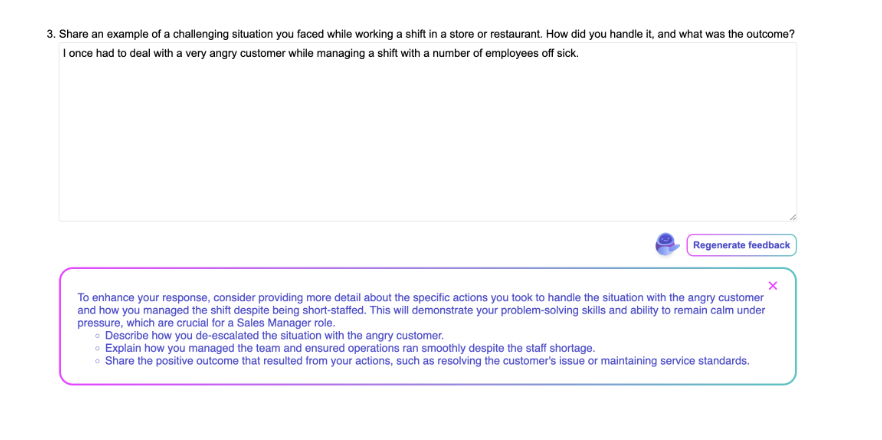
One thing I have started to see work well is using AI to help candidates give better screening responses before they submit.
Scout Talent can review a candidate’s answers to screening questions in real time, assess how well each response actually answers what was asked, and offer practical feedback on where it could be stronger. The candidate improves their answer before it reaches you.
What that means in practice is a more consistent pool of applications. You are not trying to read between the lines of a half-answered question. You get the information you actually need to screen effectively.
A Real Example
I saw a great example recently. A client introduced a short video submission as part of their process. Candidates were asked to record a 30 to 60-second video answering a couple of tailored questions related to the role.
What happened was interesting. There was a drop-off in applications. Not everyone completed the task. But the candidates who did were the right ones.
It reduced the noise. It helped the hiring team focus on a smaller, more relevant group. And they ended up making a hire from that cohort.
It was a simple change, but it made a big difference.
STAR Method
This framework can turn vague claims into measurable proof. Rather than saying “I’m a strong communicator,” candidates demonstrate how they handled a real scenario and what outcome they achieved.
For recruiters, this aligns much more closely with how decisions are actually made. It becomes easier to assess capability, compare candidates, and reduce bias because every response follows the same structure.
Below are examples of STAR Method questions:
General behavioural
- Tell me about a time you faced a challenging situation at work. What happened?
- Describe a situation where you had to meet a tight deadline.
- Give me an example of a goal you set and how you achieved it.
Problem-solving
- Tell me about a time you identified a problem before others did. What did you do?
- Describe a situation where you had to think creatively to solve an issue.
- Give an example of a decision you made with limited information.
Communication
- Tell me about a time you had to explain something complex to someone.
- Describe a situation where there was a misunderstanding and how you handled it.
- Give an example of when you had to influence someone’s opinion.
Teamwork
- Tell me about a time you worked with a difficult team member.
- Describe a situation where you had to collaborate across teams.
- Give an example of when you supported a colleague to achieve a goal.
Leadership
- Tell me about a time you took the lead on a project.
- Describe a situation where you motivated others.
- Give an example of when you had to make a tough decision as a leader.
Adaptability
- Tell me about a time things didn’t go to plan. What did you do?
- Describe a situation where you had to quickly adjust to change.
- Give an example of when you learned something new under pressure.
Simple Framework
If I had to simplify this, I would say this. Stop relying on the cover letter as a screening tool.
Instead, break your process down and look at each stage. Start with your attraction strategy. Are you bringing in the right candidates? Then look at your screening. Are you asking the right questions?
If something is not working, there is usually a gap somewhere in that process. You need to identify it and adjust. Because if you are not finding the right candidates, it is rarely just a candidate problem. It is a process problem.
The Recruitment Decision Framework
Step 1: Attraction — Are we bringing in the right people?
Goal: Reduce noise before it starts
What to define:
- A clear value proposition (why should someone join you over anyone else?)
- Role success criteria (what does “good” actually look like in 90 days?)
- Honest must-haves vs. nice-to-haves, so you’re not rejecting great people on paper
Tools that help:
- Job ads written around outcomes, not just a list of responsibilities
- A short qualifier upfront, like knockout questions or a brief video intro, to filter fit early
Step 2: Structured Screening — Can they actually do the job?
Goal: Replace guesswork with evidence
What to ask:
- 3-5 structured screening questions, consistent across every applicant
- STAR-based responses: Situation, Task, Action, Result
- Score each answer against predefined criteria on a 1-5 scale
How to assess:
- Compare candidates side-by-side, not individually in isolation
- Predefined scoring anchors keep every reviewer on the same page
Cover letters don’t show capability. Structured answers do. This is where the shortlist actually forms.
Step 3: Validation — Do they perform in context?
Goal: Test real-world ability without overburdening candidates
Options (role dependent):
- A work sample, a short task aligned to something they’d actually do
- A case study or scenario to see how they think under pressure
- A 30-60-90 day plan for senior or strategic hires
The golden rule: Keep it short and directly relevant. Long, burdensome tasks kill drop-off rates and signal disrespect for candidates’ time. If it takes more than an hour, reconsider it.
Step 4: Behaviour & Fit — How do they actually operate?
Goal: Understand how they work, not just what they’ve done
How to run it:
- Structured behavioural interview, STAR format again
- Same questions for every candidate, no exceptions
- Same scoring criteria, so comparison is fair and defensible
Focus areas: Communication, Problem-solving, Teamwork, Adaptability
Consistency here is what reduces bias. Not intention, but process.
Step 5: Decision — Compare, don’t guess
Goal: Make consistent, data-backed decisions you can stand behind
The scorecard includes:
- Screening score from Stage 2
- Interview score from Stage 4
- Work sample score from Stage 3
- Interviewer notes and evidence, not just impressions
The outcome:
- A ranked shortlist with clear separation between candidates
- A documented justification for your final hire, useful if you’re ever questioned
- A process you can repeat and improve with every new role
Why You Should Use Recruitment Software to Amplify Applicant Screening
With the right recruitment software, you can see exactly what is happening at each stage of the process. From my experience, what makes Scout Talent different is that clients can see everything. They can see all the candidates, what stage they’re at, and what actions are being taken.
It is not a black box. They can see notes, feedback, and movement through the process in real time. That level of transparency gives confidence that the process is being managed properly and consistently.
And it makes it much easier to move beyond relying on something like a cover letter alone.
Summary
In my opinion, you shouldn’t rely on the resume or cover letter to tell you who to hire.
Use it as a supporting document, not the decision-maker. Focus on building a structured process around screening questions, conversations, and the right level of assessment for the role.
Because that is what will actually help you find the right person.
About the author
 |
Carlos Amador Head of talent Acquisition, Australia Scout Talent Group With almost 18 years in recruitment spanning Japan and the wider APAC region, Carlos now heads Talent Acquisition at Scout Talent Australia, supporting both client hiring needs and Scout’s growth. His cross-regional experience provides a well-rounded view of talent markets. He values hard work, humility and not taking himself too seriously. |